Your Sustainability Toolkit












Your Productivity
Reports from the World Green Building Council confirm that well-designed interior office space can have substantial positive impacts on the health, well-being and performance of employees. We all know that when we sit in a stuffy room, with poor air flow, no windows, or it's too hot/too cold, we are less productive
Intuitively, we know sitting near a window with fresh air at a comfortable temperature brings us clarity of mind and high productivity. We describe these attributes as Indoor Environment Quality or IAQ. Estimates of performance losses from poor indoor air quality for all buildings suggest a 2-4% loss on average.
IAQ describes the condition of your workplace that contributes to your comfort and well-being. Elements like air quality, lighting, thermal conditions, and ergonomics all affect your comfort levels.
For example, your building team work hard to balance the smart systems which deliver comfortable temperatures and fresh air. Temperatures are set to a range of 22-24°, with 10% of fresh air to maintain healthy air quality. Harvard business review shows that good ventilation has been shown to reduce sick building syndrome symptoms (which costs between $10-$70 billion each year in the U.S.), cut absenteeism, and even reduce infectious disease transmission.
Want to know more about what you can do to improve your comfort and well-being at work?
Top Tips for being at your best

Look after yourself first and get enough rest! The research tells us we need 7-9 hours' sleep each night. The office can positively impact mood, sleep, stress levels and psychosocial well-being.

Take regular breaks. Perhaps take a spin around the block and get some fresh air and sunshine. We know that standing is the new sitting, and walking is even better! So take the opportunity to host a walking meeting - you will be surprised how efficient a short walking meeting can be! Plus, you'll get those endorphins going so everybody will feel better!

Stay hydrated. We are all meant to consume at least 2Lts of water every day. Keep a jug at your desk, or use the excuse to get up and stretch the legs every 45mins and refill your glass.

Keep plants at your desk. The benefits are both physical and psychological. Plants can offer visual relief, reducing stress, improving the overall impression of a workplace. Of course, they also improve the air quality by removing carbon dioxide in the air.

Make smart meal choices. Studies tell us that our food choices effect our overall cognitive ability. We all know that 3.30pm decline post pasta feeling! We also know that we need to feed the brain to stay focused, which is why it's hard to focus on an empty stomach. Keep healthy snack choices at your desk, opt for an herbal tea once in a while, and decide what you're having for lunch before you leave your desk!
Workplace Well-being
Beyond the choices you can make to improve well-being, your office can also improve your clarity of mind at work. Careful design of the office can improve employee mood and morale. A well-being workplace can be designed to mitigate stress and optimise productivity.

Elements such as art, vegetation, variable work spaces, dynamic furniture (such as sit-stand desks) can enable improved productivity by tailoring the workspace to the task. For example, quiet spaces for dedicated thinking and problem solving, or communal areas for collaboration.
Office spaces are evolving rapidly in response to remote work, technology advancements and the need to innovate. Open plan layouts have been adopted as best practice in workplace design. Activity Based Working (ABW) has become common place, and requires a variety of spaces for the employee to select from, depending on task variability. ABW can enable better collaboration, spontaneous meetings, and ultimately increased productivity. It’s also important to recognise that it doesn’t work for everyone or every role, and the jury is still out on its ultimate longevity.
Critical elements of a productive and healthy workplace

Special comfort and individual space

Visual Comfort

Indoor Air Quality and Thermal Comfort

Personal Control and Building Image

Noise Distraction and Privacy

Overall Satisfaction
Your Amenities
Your productivity can be improved by getting outside during the day. Not only does getting outside break up the day, but also a quick walk around the block can refresh and improve clarity of mind.
Your building is located centrally, with access to parks, gyms, public transport, pools, and hosts End of Trip Facilities.
The map below illustrates where your most convenient amenities are located. In addition to public amenities, the map also illustrates routes for walking meetings, or a lunchtime run.
To see what else is nearby, click on this Google Maps link. For transport times, walking and cycling routes, enter your destination and select the relevant icon.
For more information on your public transport options and timetables head to https://transportnsw.info/.

Your Fitout
The way we work is changing as technology offers more flexibility. We no longer work in enclosed cubicles, and rarely find a use for a fax machine. Beyond technological enablers, the design of our work space has morphed into open plan, flexible spaces, abundant with greenery.
When designing your fit out, there is a lot to think about. Starting with the basic practicalities of accommodating your team’s functional needs, to considering amenities, space planning, furniture and material selections, and most importantly, selecting the right coffee machine. Beyond the design, you might also think about the environmental aspiration of your fit out, to maximize recycled content, avoid landfill and reduce toxins.
Before you put pen to paper, consider the following benefits of a best practice fit out.
Corporate social responsibility starts at 'home', by using your workplaces as a practical demonstration you can showcase an innovative, responsible, future proof environment to clients and employees!
Employees know their wellbeing at work affects not only their productivity, but their
workplace
satisfaction and enjoyment. We know that staff are more likely to stay at workplaces
where they are
happy.
Likewise, organisations' environmental and social responsibility reputations are
being examined more
closely than ever as a new generation of staff want to choose employers whose values
align with their
own. What better way to showcase your environmental credentials than on your own
home turf?
Workplace design influences the way staff share and develop knowledge. What better way to encourage an open, flexible and creative workforce than through an open, flexible and creative workplace? The research says informal interaction improves organisational learning, a crucial component of business success and productivity.
Energy costs money. Water costs money. Sending waste to landfill costs money. Resource efficient design can reduce costs for your business, allowing you to spend money where it counts. By getting it right the first time, you can reduce your on-going lease costs associated with relocation.
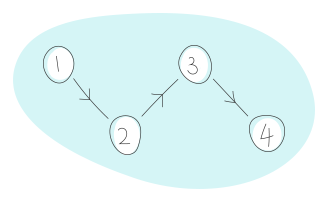
Four step process
When moving into a new office there are lots of things that you need to be thinking about simultaneously. Your Investa Property Management Team is here to walk you through the process and ensure that you’re able to design and build a healthy low carbon office.
We’ve identified the following four easy steps to get you set on that pathway.
These can be for both environmental and wellbeing performance and can include
items such as;
Embodied carbon is a lifecycle assessment charting the total
environmental impact
of that office desk from the moment it is a tree, all the way to the end of its
lifecycle when it
will (hopefully) be recycled. Reducing the embodied carbon of your office fit
out reduces the total
environmental impact of your workspace.
Recycled and recyclable content is the content in your office
that has either been
recycled from something else, or can be recycled when you’re done with it. You’d
be surprised how
much can be made of old office furniture, with the high timber, plastic and
paper contents lending
themselves to common recycling practices.
Reused content is the content you’re able to reuse from both
your previous
workplace and the previous occupants of the space you’re able to move into.
Reusing existing
furniture is not only great for the environment, but it also reduces the
significant cost of buying
brand new items.
Operating carbon is the operational impact of running your
office. The more energy
and water efficient your fixtures, the more you’ll save on utility bills. And
not only will you be
saving energy and water, but you’ll be reducing the associated carbon of running
your office.
Achieving environmental ratings. Ratings make tangible the
great work done when
designing and building your office. This lets you easily communicate the
benefits of working in your
office to existing and future staff. Engaging your teams on setting the targets
is also a great way
to drive employee ownership of your new space.
It's important to have your design team involved from the very beginning so they can tailor the project to meet your expectations.
Moving workplaces can be hard for employees, especially with the evolving way of working meaning that changing addresses means a lot more than just changing desks. Keeping employees involved in the process is crucial to ensure a smooth transition to your new office and reduce disruption to your business.
Once you are in and settled, check back in with your target, and report your
scores to your teams.
Conduct some initial surveys to see how staff are adjusting to the new space.
See what’s working,
and what’s not.
Make adjustments where things aren’t working as you’d imagined.
Moving to your new office
Reusing Existing Office Fit Out
This starts at the very beginning, when you’re still at your current, soon to be old home. When moving out of your existing office tenancy it’s important to try and reuse whatever you can. All office materials, from the lights and carpets to every last work station often end up in landfill. Let’s do what we can to reduce that!
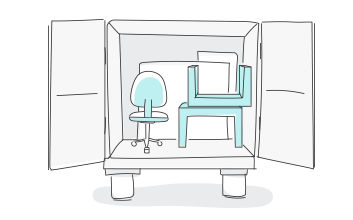
Ask your existing building manager if it’s possible to leave fixtures and furnishings in good condition so that they can be reused or repurposed by the future tenants. Not only will this reduce costs for both of you, but it will reduce the environmental impact of your move.
If neither you nor your old builder want it, there are plenty of charities, NGOs and start-ups who would gladly take some old office equipment off your hands. A helpful way to start this process is to create an inventory of the items that would otherwise go to landfill.
Once you’ve created the inventory, contact your existing building management team to see if they have a fit out reallocation programme, or contact a charity you support to offer them the items, or failing those two options, distribute the items amongst staff. You’d be surprised how even a small amount of old office furniture can make a big difference.
The Better Buildings Partnership's Strip-out Waste Guidelines provide more detail on this. Once you’ve put your old home behind you, it’s time to start working on what the new one will look like.
Before demolishing the old asset at 151 Clarence St in Sydney, the Investa Property Team were able to recycle and repurpose over 9 tons of office furniture. A lot of this went to the Butterfly Foundation, a charity providing health and education support programs for Australians with eating disorders. More desks and chairs meant they could continue to provide support, treatment, prevention, early intervention, education and training for young Australians in school and their families.

Green Star workplace (formerly known as ‘Green Star Office Interiors’) is the
Green Building
Council of Australia’s (GBCA’s) nationally recognised standard that assesses an
office interior on
all key areas of environmental performance.
Green Star interiors rates the capability of the office design to reduce
environmental impact,
rather than its actual performance in operation. The Green Star Office Interiors
tool is easy to use
and can be downloaded from the GBCA’s website.
A Green Star workplace rating can be used to demonstrate leadership in the
design and construction
of your workspace. It will help ensure your office is a comfortable, productive
and healthy place
for staff to work. The rating can also help you to minimise ongoing costs such
as energy and water
bills.

Much like your building has a NABERS rating which measures the buildings energy
efficiency for
shared services like lifts and air conditioning, you can also have your tenancy
rated for energy
efficiency. A NABERS tenancy rating will enable you to measure and rate your
energy usage and the
associated greenhouse emissions from your office. This rating tool is a terrific
way to communicate
a score card on performance to your teams at work.
If you decide to rate your new fit out prior to the construction stage, you
can begin to
advertise your targeted rating straight away, showcasing your environmental
commitments to employees
when moving locations. For more information on NABERS you can visit the NABERS
website. Alternatively, this NABERS Energy Management Guide for Tenants - Google Search is also pretty
handy. As always, your Investa Property Management Teams are always there to
provide support in
achieving

The International Well Building Institute, established in the USA, has developed a tool to guide the design of work places which have a positive impact on the tenants (that’s you!) health and well-being. The tool outlines seven key criteria for consideration in designing your new workplace; Air, Nourishment, Water, Light, Fitness, Comfort and each of the seven features must be considered to achieve certification. Your Investa Property Team can assist you in achieving a WELL certification for your new office.
Your Lighting
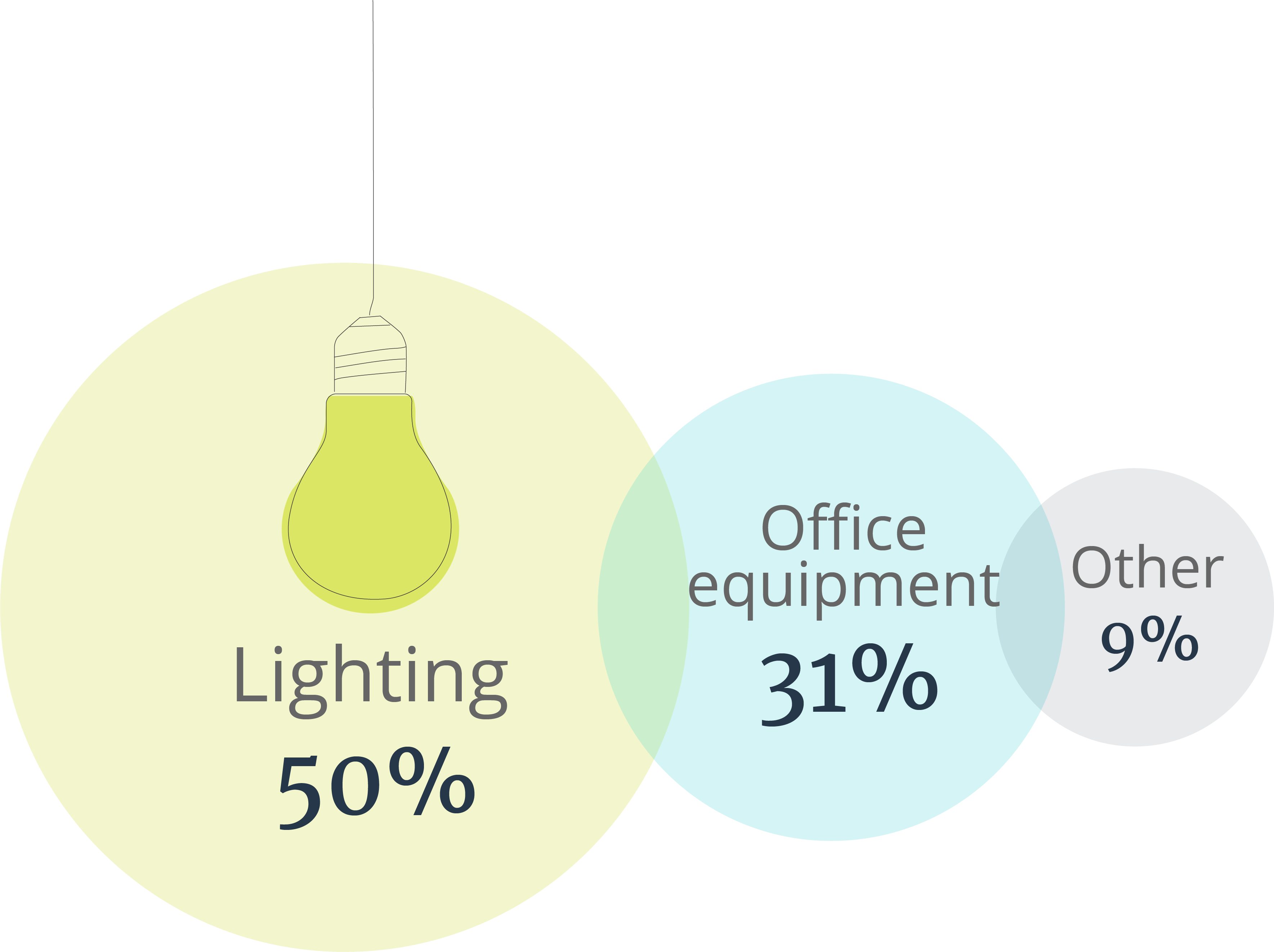
The lighting in your new office will account for more than 50% of your energy costs and represents the largest single opportunity for energy savings.
If you've chosen an office space with lots of natural light, you’re already ahead, good job by you! And even if you didn’t, there are still significant savings to be had.
The Technical Specifications section of the Tenant Information Manual showcase Investa's recommended best practice lighting showcase Investa’s recommended best practice lighting. This includes the inclusion of control lights with motion based sensors and the placement of light sensors near windows. Even something as simple as painting your office walls and ceilings a light colour can reduce the demand placed on lighting and lead to associated cost savings.
Beyond the office lighting, don’t forget to turn off monitors, printers, PC’s and coffee machines when they’re not in use. These elements can create heat, which the building needs to cool overnight to ensure it’s comfortable for you when you arrive in the morning.
Your floors
Over the life of an average office building, floor finishes have the greatest single environmental impact of any fixed item. This is because they tend to be replaced at the end of every lease cycle.

We’d love for you to be able to keep the existing floor finishes within your tenancy, but if this isn’t possible (or if they’re really, really ugly), there are lots of environmentally friendly options available at similar and often cheaper costs than standard alternatives.
When considering what carpets to use, look for;
- Modular carpets (like tiles), which are easier to repair and replace and result in less waste
- High recycled content
- Minimise virgin (non-recycled) PVC content
- Enquire if there is a lease option or manufacturer take-back program
- Minimise use of pesticides and fire retardants
- Measures in place to reduce ecological impact of manufacturing process.
Your walls and ceilings
Work places have changed since the days of the 1950’s offices and secretary pools, and thank goodness! More and more of us work in open plan offices, making it easier to talk to colleagues, and spontaneously collaborate.
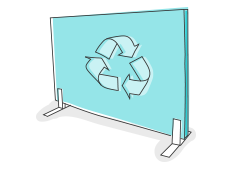
Fewer walls also mean reduced fit out expense, more natural light and more effective air conditioning and lighting which results in direct financial savings.
If you do choose to put in some new partition walls and ceilings, we ask that they be modular with re-useable elements, composed of a high-recycled, eco-preferable content. Likewise, all wall linings and glazing frames used should have a high recycled content.
Lastly, as per the Sustainability section of the Tenant Information Manual, we ask that you please leave enough room for return air grilles in your walls so that return air from the HVAC system can move through the space efficiently. This ensures that you remain comfortable all year round.
Your joinery
In designing your fit out, you may have identified existing doors, built-in joinery and kitchens you can retain. This is a terrific way to reduce both cost, and environmental impact of your fit out.
If you do require new joinery, then we encourage you to use recycled, FSC-certified, plantation or any other low emissions composite timbers. Otherwise, you run the risk of using old growth timber from a rainforest, the logging of which usually results in a severe loss of Australian biodiversity. Not cool.
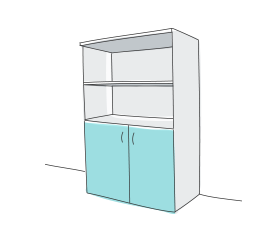
These old timbers often contain formaldehyde and other volatile organic compounds (VOCs). That’s bad. Exposure to VOCs has been linked to a range of health problems including headaches, fatigue, respiratory problems and skin irritations.
So using certified sustainable timbers, as well as low emissions laminates, finishes and glues allows us to create a healthier indoor environment for your employees.
Your Paints, sealants and adhesives
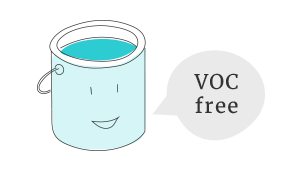
Thankfully all those funky colors (and all those boring shades of ‘off white’) come in low VOC (Volatile Organic Compounds) options.
So, when choosing paints for your office, make sure they are low VOC - your staff will thank you for using environmentally sustainable options, that don't have that toxic "new paint" stench.
Your Bathrooms and toilets
If you get to design new bathrooms for your new tenancy (fun!), then installing efficient fittings and fixtures won’t cost you a single extra dime.
In fact, water efficient design will only save you money on your water bills over the course of your lease. Alternatively, if you’re upgrading existing bathrooms, there are some very cost-effective things you can do to reduce your water use. Or – as is usually the easiest option – it’s also great to do nothing and keep the existing tenancy bathrooms!

The Australian Government has put together some useful resources on water efficient design, with their creatively named Water Efficiency Labelling and Standards (WELS) scheme providing an outlet to showcase your great work!
Your Supplementary air conditioning
If your office needs supplementary air conditioning for server rooms or otherwise, it’s important to choose the most energy-efficient system. We’d recommend basing your choice on cost over the life of your lease in preference to upfront cost.
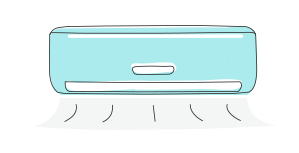
Since air conditioning is a major contributor to peak demand for energy it can contribute disproportionately to energy bills by creating high peak ‘capacity charges’ which, even though they’re only short events, can add to electricity bills.
Efficient management can have a great impact too, with proper maintenance and usage able to reduce energy consumption by up to 50%.
As per your Tenant Information Manual, installing supplementary air conditioning specified for maximum efficiency and arranging for regular maintenance and annual reviews of set points and timers will ensure these important goals are met.
It’s important to size the system correctly according to your needs and the existing base building system. If your air conditioner is too big it will cycle on and off more, reducing efficiency and creating greater temperature fluctuations. That’s bad. This also causes parts to wear out more quickly. That’s also bad. Let’s make sure we get this right.
Lastly, if your supplementary air conditioning unit is water sourced and connected to the base building systems, you’ll have to install and program a solenoid valve to ensure the water flow is stopped when the compressor is cycled off. This will save a bunch of water and energy when your air conditioning unit is turned off and we no longer have to run power to the unit.
Workstations and office furniture
Keeping existing workstations and office furniture is the cheapest, most environmentally smart, and quickest way to fit out your office. If that isn’t an option, or if the existing furniture looks like it belongs in a terrible late 90s sitcom, we’d love to see you fill your home office with cost-effective, environmentally friendly and healthy (no or low-VOC toxin) products.
In terms of a Cradle to Grave consideration, the best workstations are those which are designed for easy disassembly, reuse and recycling. So not only can you reconfigure your working set up if you don’t like the person you’re sitting near, but you – or someone else – can easily reuse the furniture when it’s time to say goodbye. This helps reduce the ‘churn’ of old office furniture constantly being sent to landfill, which will reduce waste bills whilst helping the environment.
When considering what workstations and furniture to invest in, we’d love you to consider the following;
- Design and fabrication that minimises materials use and waste and focuses on natural and renewable materials as well as recycled and recyclable content
- The proportion of recycled, FSC-certified or plantation timber
- Design for easy disassembly and reconfiguring (this will also help us reuse and repurpose everything at the end of your lease!)
- Manufacturer take-back scheme
- High durability to avoid costly repair and replacement
- No or low-VOC glues and solvents (including those used in MDF/ply)
- Measures in place to reduce ecological impact of manufacturing process
Smart office equipment
Office equipment accounts for approximately one third of the average tenancy’s energy use, with most of this attributed to computers and monitors. Buying your staff fancy, high-efficiency tech is only half the battle, with energy being used in an empty office by computers and screens which have not been turned off overnight an easy first step to take.

This is just one small choice you can make everyday to reduce the financial and environmental cost of your tenancy. All data centre equipment, computers, monitors and everything else is rated by the Australian Government for energy efficiency, with the star rating on an asset indicative of its energy efficiency.
When your equipment is being delivered and set up, ensure energy efficient settings are selected, and ask your supplier to demonstrate how to use the best power management settings. Significant energy savings can be achieved just by having everything running in the right mode. Be sure to let staff know too, it’s amazing how much sustainable preaching people will tolerate when they’re about to be handed a shiny new laptop!
Indoor plants
The science tells us that indoor plants contribute positively to the wellbeing of building occupants by reducing airborne concentration of VOCs. They've also been shown to improve the indoor environment, relieve anxiety, reduce CO2 concentration, increase productivity and decrease respiratory disorders.

Purchasing office consumables
Demonstrate your organisation's commitment to corporate social responsibility by using your office purchasing power to select socially responsible products with low environmental impacts. Now more than ever, people are using less and less physical office products such as pens and highlighters. So, consider how many you may actually need given the technological advances available to us!
Buying from local suppliers is a great way to reduce transport costs and support the local community. Choose products that are recycled and recyclable. We know that recycled paper is the most sustainable paper option by using less energy and water, producing lower carbon emissions in the manufacturing process and reducing the amount of waste sent to landfill, as paper can be recycled 4-5 times. You won't even notice a difference in quality, with recycled paper being just as white as non-recycled paper.
The UK based Recycled Papers makes the case better than we could, showcasing the benefits of using recycled paper to employees, clients and other stakeholders who are easily exposed to this sustainable choice.
Caffeine, my old friend
Who doesn't love a good coffee or tea?! But sadly, coffee cups cannot be recycled in traditional recycling facilities. This is because of the plastic lining on the inside of the takeaway cup, which is also harmful to human health.

Nobody wants to contribute towards the 2.7 billion takeaway coffee cups that go to landfill each year!
Here's 4 tips to curb your takeaway coffee cup habit:
1. Don't use a takeaway cup! Take a seat and enjoy your drink at the café from a ceramic cup. Fact: it takes an average of 5-10 minutes to consume your beverage.
2. Bring your own cup. Guess what? You will probably get a discount! And, this doesn't even need to be a 'keep cup', you can simply grab a mug from the office cupboard and take it to your favourite café. Now that's innovative!
3. Support sustainable responsible cafes that promote a circular economy with reusable mugs.
4. If none of the above options are suitable, say NO to the lid of your takeaway cup. And promise us that you will remember steps 1, 2 and 3 next time!